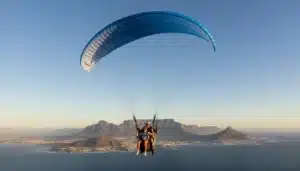
Pushing the limits of human experience is an important part of what paragliding’s all about. But there are always those of us who want to push things well, perhaps a little too far. Even the most sane, level-headed person can transform into a thrill-seeking daredevil once their feet leave the ground. On that note, here are a few of our favourite stunts we recommend leaving to the pros unless taught under expert paragliding instruction in a safe environment:
1. The Deep Spiral
When Big Ears just isn’t enough, the Deep Spiral can offer a terrifyingly fast, effective way to drop altitude, assuming you don’t mind a little motion sickness. By shifting weight to one side and pulling the brake, pilots reach drop sink rates in the neighbourhood of 10-18 m/s with rotation speeds of 125 km/h and up. It’s sort of like a carousel in the air, except that you’re plummeting to the ground with a gravitational force up to four times stronger than what you’re used to.
2. Obstacle Flying
Some nutcases pilots have perfected the art of paragliding uncomfortably close to structures and other dangerous obstacles: charting courses next to radio towers, along cliff edges, or, for the particularly suicidal, between and from buildings. Needless to say, this type of stunt is extremely dangerous, with a room for error so small it can be expressed in microscopic terms. While such stunts may make for entertaining viewing on YouTube, pulling them off in real time requires a lot of expert skill. Remember: crash landing on someone’s balcony is not only bad for your health, but it can also lead to some pretty awkward lawsuits.
3. Infinity Tumbling
If there was ever a stunt to end all paragliding stunts, this is it. The Infinity Tumble is one of the most punishing inventions of the paragliding world, pitting pilots and their equipment against gravitational forces surpassing 6G (remember that temporary vision loss, or seeing grey, is possible at any point past 4.1G). Basically, the Infinity Tumble is a series of consecutive somersaults that sends the pilot over the wing in a perfect vertical line. Side effects may include dizziness, vertigo, and a lifelong fear of tumbling.
4. The Helicopter
This deceptively simple paragliding stunt is also one of the trickiest manoeuvres to pull off. By keeping the glider totally open, the pilot is able to rotate the wing in a slow, controlled spin like a helicopter propeller, hence the name. Unlike the Deep Spiral, the Helicopter feeds a fairly low sink rate around 2 to 3 m/s and forces the pilot to stay directly under the wing. Perhaps the hardest part of the trick is preventing the riser from getting twisted during rotation, making it crucial for pilots to fly seated with a mostly open chest strap.
5. Synchronised Pitch Pendulums (Molineti)
Sometimes the daredevil gene comes in pairs. Case in point: the Rodriguez brothers, Félix and Raul, who in 2001 devised this particularly wild two-man synchronised stunt. For this trick, two pilots fly alongside each other and perform alternating pitches or dolphines. The result is something of a spectacle while one pilot follows the upswing, the other swoops below, forming a perfectly timed double pendulum. Of course, even the slightest miscalculation of timing can send the pilots crashing into each other, which seems like a good opportunity to remind everyone NOT to try any of these at home.
FAQs
The Deep Spiral is a paragliding manoeuvre that allows pilots to descend rapidly by shifting their weight to one side and pulling the brake. This results in high sink rates ranging from 10 to 18 meters per second and rotation speeds exceeding 125 km/h. The Deep Spiral can be compared to a carousel ride in the sky, but with significantly more intensity due to gravitational forces up to four times stronger than normal.
Obstacle Flying is a daring paragliding stunt where pilots navigate dangerously close to structures such as radio towers, cliff edges, or even between buildings. This type of flying requires exceptional skill and precision due to the minimal margin for error, which can lead to catastrophic accidents or crashes.
Infinity Tumbling is considered one of the most extreme paragliding stunts, involving a series of consecutive somersaults that send the pilot over the wing in a vertical line. This manoeuvre subjects the pilot to gravitational forces exceeding 6G, which can lead to temporary vision loss or 'seeing grey' beyond 4.1G.
The Helicopter is a paragliding manoeuvre where the pilot keeps the glider fully open, allowing it to rotate slowly and be controlled like a helicopter propeller. This results in a low sink rate of about 2 to 3 meters per second. The pilot must maintain a position directly under the wing and manage the risk of riser twists during rotation.
Synchronised Pitch Pendulums, also known as Molineti, is a two-man paragliding stunt devised by the Rodriguez brothers in 2001. It involves two pilots flying in close proximity and performing alternating pitches or dolphines, creating a synchronised, double pendulum effect.