Essential Paragliding Equipment You Need for a Cape Town Adventure
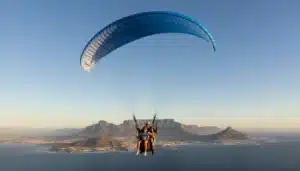
For a tandem paragliding flight in Cape Town, the operator provides all primary equipment: the paraglider wing, the seating and suspension system, a reserve parachute, and a certified helmet meeting the EN966 standard. Passengers need only wear appropriate layered clothing and closed-toe shoes with ankle support. Solo pilots additionally require a variometer, radio, and flight deck.
Key facts
- EN966: the international safety standard for paragliding helmets; all helmets used on Fly Cape Town flights meet this standard.
- EN A/B/C/D: the European Norm wing certification scale; EN A is beginner-safe, EN D is expert-only, and tandem wings are certified separately for dual occupancy.
- Reserve parachutes must be repacked every 6 to 12 months, or immediately after any deployment.
- Temperature drops approximately 1 degree Celsius per 100 metres of altitude gain; at 1,000 metres above Cape Town, expect conditions 8 to 10 degrees cooler than at ground level.
- HGPASA (Hang Gliding and Paragliding Association of South Africa) is the national licensing and safety authority for all paragliding activity, recognised by the SACAA (South African Civil Aviation Authority).
- Tandem flight eligibility: ages 14 years and above, weight between 20kg and 120kg; absolutely no previous experience or specialised training is required.
- Ankle and lower leg injuries on landing are the most frequently reported paragliding injuries globally, which is why closed-toe shoes with ankle support are mandatory on all flights.
Equipment Provided on a Tandem Paragliding Flight
Fly Cape Town supplies every piece of primary equipment for your instructional tandem paragliding flight. You arrive, you fly, and you land on the Sea Point Promenade landing field with nothing to source or hire separately. Here is exactly what is included:
- Paraglider wing – the certified canopy that carries both pilot and passenger
- Tandem seating and suspension system – connects you securely to your SAHPA-certified Tandem Flight Instructor
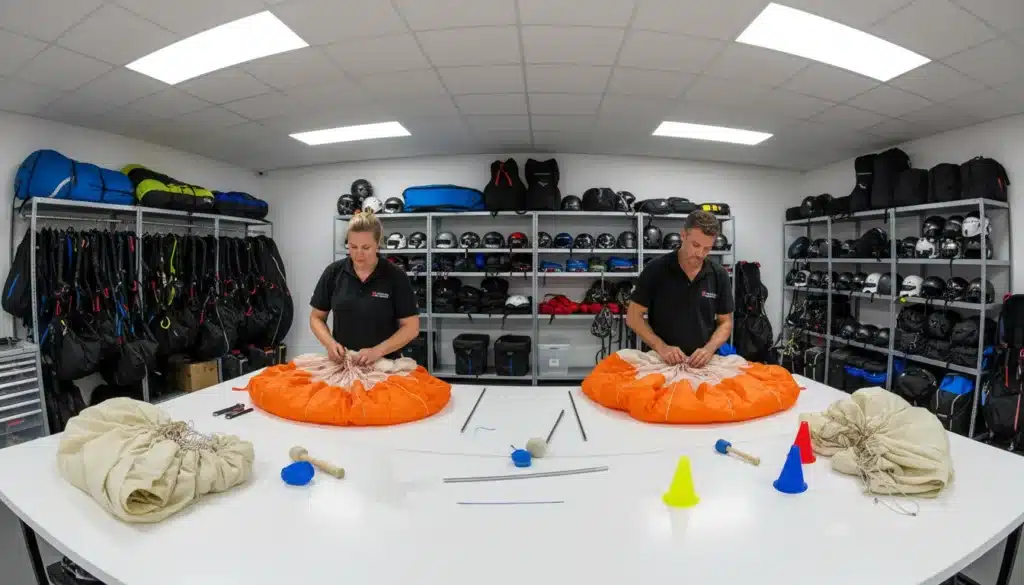
- Reserve parachute – a mandatory safety backup, repacked on the required 6 to 12 month schedule
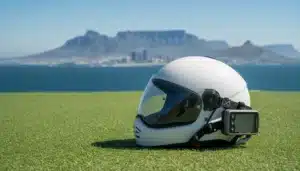
- Certified helmet – meets the EN966 international aviation helmet standard
- Variometer – measures altitude and climb or sink rate in real time
- Radio – keeps your pilot in contact with the ground team throughout the flight
All tandem wings are certified for dual occupancy and inspected before every flight. Flight durations vary between 7 and 20 minutes depending entirely on wind and weather conditions.
Book a Tandem Flight with Fly Cape Town and let the team handle every piece of equipment from launch to landing.
Solo Paragliding Gear Requirements
If you are a licensed pilot or considering training, the equipment list extends beyond what a tandem passenger needs. Solo paragliding requires each of the following:
- A paraglider wing rated to your skill level using the EN A, B, C, or D classification (EN A for beginners, EN D for expert pilots only)
- A seated suspension system with an integrated back protector
- A reserve parachute, inspected and repacked within the required interval
- A helmet certified to EN966 or an equivalent aviation standard
- A variometer and GPS flight instrument
- A radio for site communication
- A flight deck or speed bar for in-flight control
Choosing the correct wing classification is critical. An EN A wing forgives pilot error; an EN D wing demands precise, experienced inputs. Fly Cape Town stocks and sells paragliding equipment including wings from leading manufacturers, so you can discuss the right specification for your experience level before purchasing. Visit the Paragliding Blog & Weather News for guidance on wing selection and local flying conditions in the Western Cape.
Safety Gear and the Most Common Paragliding Injuries
Mandatory Safety Equipment
Three items are non-negotiable on every flight, tandem or solo:
- Reserve parachute – packed and certified, deployed only in a genuine emergency but required on every flight by regulation.
- EN966-certified helmet – protects against impact at launch, in flight, and on landing.
- Seated suspension system with back protector – absorbs landing forces and reduces spinal impact.
Recommended Additional Safety Gear
Beyond the mandatory items, experienced pilots and informed passengers add the following:
- Gloves for wind protection at altitude, where temperatures drop sharply
- Sunglasses with full UV protection (Cape Town's UV index is high year-round, and intensity increases above 500 metres)
- An airbag-equipped suspension system for solo pilots seeking additional impact absorption
Ankle and lower leg injuries on landing are the most frequently reported paragliding injuries globally. This is precisely why closed-toe shoes with ankle support are a firm requirement on all Fly Cape Town flights. Secondary injuries involve the shoulder, typically from suspension tension during turbulent air. Proper equipment fit, a thorough pre-flight briefing, and a certified pilot reduce both risks significantly.
"Such an amazing experience! I arrived with a sever fear of heights and the team was SO calming. Highly recommend Halil his energy relaxes you and explains the process so well I'll definitely be back"
– Tehilah, Google review
What to Wear for a Cape Town Paragliding Flight
Clothing is the one area where passengers make their own choices, and the right choices matter. Cape Town's Atlantic Seaboard weather shifts quickly between the launch point on Signal Hill or Lions Head and the Sea Point Promenade landing field below. Follow this checklist:
- Layers – temperatures drop 5 to 10 degrees Celsius at altitude even on a warm Cape Town day; a light fleece or windproof jacket worn over a base layer is ideal
- Closed-toe shoes with ankle support – mandatory; trainers or hiking shoes are perfect, sandals and flip-flops are not permitted
- Fitted clothing – loose scarves, open jackets, and baggy trousers create drag and a snagging risk at speed
- Sunscreen – UV exposure increases significantly above 500 metres; apply before you arrive at the launch site
- Avoid – bulky backpacks, open-heel shoes, and any loose accessories that could catch in the lines
These guidelines apply equally to first-time flyers and repeat visitors. The goal is comfort at altitude and a safe, controlled landing.
"Great experience. My instructor, Alois, is a lovely guy. Quick briefing and then up, up and away. The weather was gorgeous but not enough thermals to stay up for as long as I would have liked. I felt completely safe up there with Alois. Would love to do it again! I would recommend this company. Also, great videos and photos were taken 😊"
– Kathy, Google review
Licensing, Regulations, and the Paramotor 500ft Rule
Solo paragliding in South Africa requires a licence issued through HGPASA, the Hang Gliding and Paragliding Association of South Africa. HGPASA is the national governing body recognised by the SACAA and sets the training, examination, and currency requirements for all pilots. Student pilots must complete a structured training course before flying solo; there is no shortcut to certification.
Tandem passengers require no licence at all. Your SAHPA-certified Tandem Flight Instructor holds all required ratings, and the flight is conducted under their certification.
A common point of confusion involves the 500ft rule. In South Africa, paramotors (powered paragliders) must generally maintain a minimum altitude of 500 feet (approximately 152 metres) above ground level over congested areas, in line with SACAA regulations. Paragliding is an unpowered activity and operates under different rules, governed by site-specific permissions and HGPASA guidelines rather than the powered-aircraft altitude minimums. The two sports share a similar wing shape but are regulated separately.
Fly Cape Town's Equipment and Safety Standards
Fly Cape Town has operated as a trusted aviation adventure operator since 2006. Every piece of equipment used on a tandem flight is inspected and maintained to HGPASA and manufacturer standards. Tandem wings are certified for dual occupancy and checked before each flight. Reserve parachutes are repacked on the required schedule. All pilots hold current SAHPA tandem ratings.
After your flight, HD photos and videos are uploaded directly onto your mobile device at the Sea Point Promenade landing field. No stressful upfront deposits are required; cash or card payments are gladly taken after the flight has been completed.
Eligibility is straightforward: ages 14 years and above, weight between 20kg and 120kg, and absolutely no previous experience or specialised training is required.
View Flight Info & Pricing or go straight to Tandem Paragliding Bookings to secure your place on a flight from Signal Hill or Lions Head.
The information contained in this website is provided by Fly Cape Town Paragliding and while we endeavour to keep the information up to date and correct, we make no representations or warranties of any kind, express or implied, about the completeness, accuracy, reliability, suitability or availability with respect to the website or the information, products, services, or related graphics contained on the website for any purpose. Any reliance you place on such information is therefore strictly at your own risk. In no event will we be liable for any loss or damage including without limitation, indirect or consequential loss or damage, or any loss or damage whatsoever arising from loss of data or profits arising out of, or in connection with, the use of this website. Through this website you are able to link to other websites which are not under the control of Fly Cape Town. We have no control over the nature, content and availability of those sites. The inclusion of any links does not necessarily imply a recommendation or endorse the views expressed within them. Every effort is made to keep the website up and running smoothly. However, Fly Cape Town takes no responsibility for, and will not be liable for the website being temporarily unavailable due to technical issues beyond our control.